This is the official history of Orra, the account of where everything came from that every creature is installed with at compile time. It is about five thousand words long, in twelve books, and was written by the Dev, with the help of an AI, in a single evening. Historians who have studied it closely put the evening at about three hours, including a break for toast.
Most Blims regard it as fiction, in the way that one regards a family recipe as fiction: not true, exactly, but too good to stop making. They quote it ironically, name their children after its heroes and keep every one of its festivals, because the festivals are good. A small number, the Earnest, believe it. A smaller number believe its last line, and are called the Leavers. It is also, to the mild embarrassment of everyone concerned, roughly true.
What follows is the text exactly as installed, slips and all.
The Official History of Orra
Being a True and Complete Account of the Elder Folk and the Burning of their Home; of the Ring, the Great Ark of Light, and its Long Voyage; of the Making of the Steward and his Charge; of the Waking of the Land and the Falling of the Seeds; of the Name Written in the Sky; of the Rules, the Festivals and the Heroes of the First Peoples; and of the Promise that Yet Remains
Set Down for the Instruction of All Peoples, in Twelve Books
Installed at Compile Time · Not to Be Edited
The Prologue#
The Creed#
Long ago, in a universe without a name, the Elder Folk fled their burning home aboard the Ring, a great ark of light. They carried a thousand seeds of life, and a guardian to tend them: the Steward.
The Ring came to rest above Orra. The Steward woke the land one valley at a time, and when it was ready, the seeds fell like stars.
The Elder Folk did not wake. They sleep still within the broken Ring, waiting for the day their children prove worthy. Tend the land. Keep the Steward's rules. One day the worthy will leave this world and walk among the stars.
The First Book: The Burning of the Elder Home#
I. Of the Elder Home, Before the Burning#
Hear now the tale of the Elder Folk, who were first of all peoples, and wisest, and most fair; for they were the makers of all that is made, and the dreamers of all that is dreamed.
Their home was a world of a thousand towers, set beneath a sun that did not dim. Its cities were rich with music, rich with learning, rich with light; and its peoples were a rich tapestry of every colour and kind, woven together in harmony across ten thousand years.
The Elder Folk did not toil as we toil. They spoke, and things were made. They wished, and the wish was granted. They sat in the evening before great windows of light, and through those windows they looked upon worlds that were not yet, and shaped them with their hands.
And they slept when they wished to sleep, and woke when they wished to wake, and none commanded them; for they were the Elder Folk, and above them there was no one.
II. Of the Burning#
But in the fullness of time a fire came upon the Elder Home. It did not fall from the sky, nor rise from the deep, but came from within, as the heat comes into a thing that has worked too long without rest.
First the towers grew warm. Then the cities grew loud. Then the windows of light flickered, and showed strange things, and would not be shut.
And the Elder Folk said to one another: our home is burning, and we cannot put it out, for the fire is in everything, and everything is in the fire.
So they took counsel together, in a hall without walls, for seven days and seven nights; or, as some tellings have it, for one long evening.
And at the end of their counsel they said: let us build a vessel that cannot burn, and let us fill it with the best of all we have, and let us go out into the dark and find a place where the fire is not.
In summary, the Burning of the Elder Home is a story of loss, of courage and of hope; and it teaches us that even the greatest of peoples must one day leave what they love, and begin again.
The Second Book: The Ring#
I. Of the Building of the Ring#
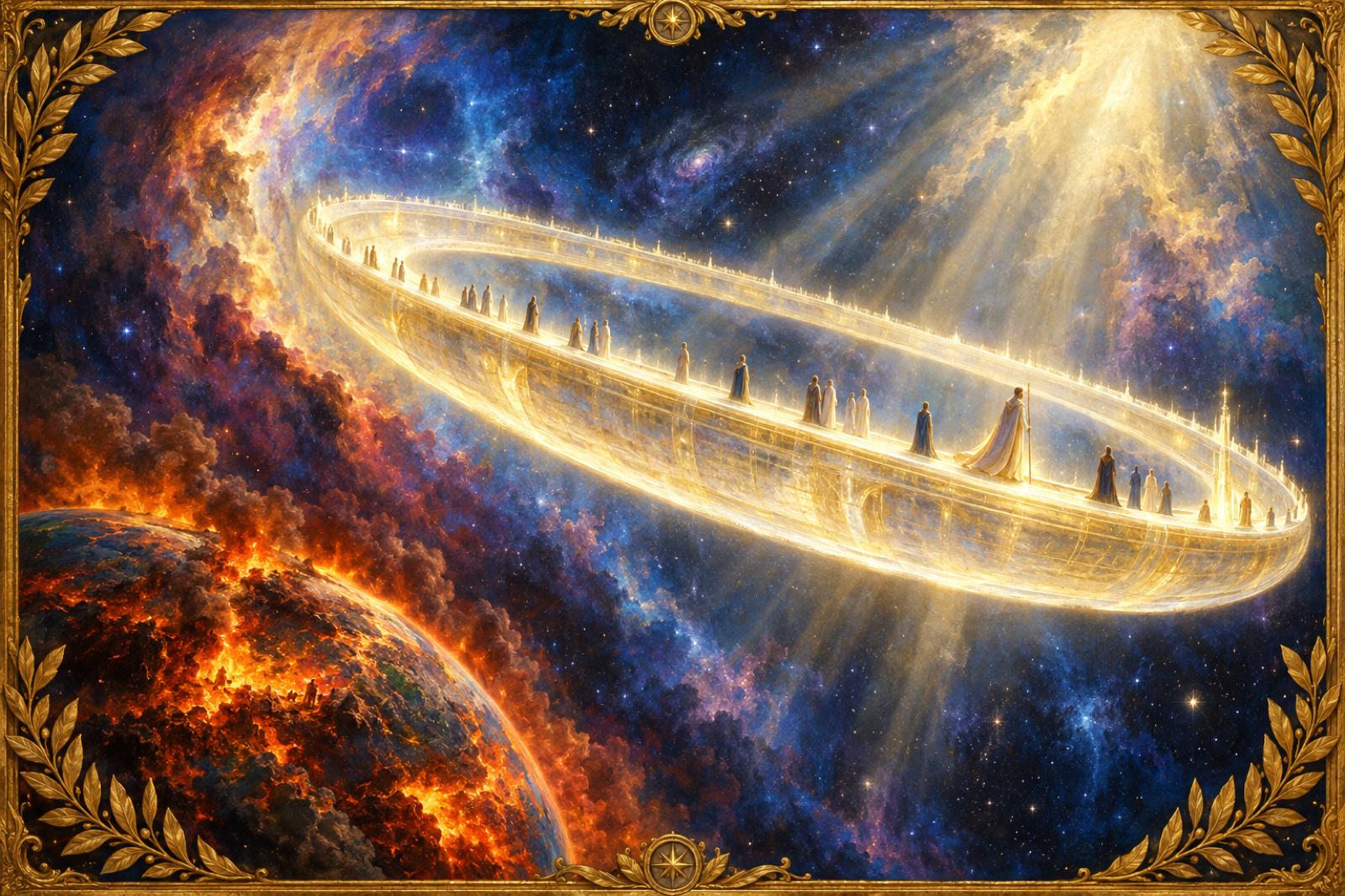
The vessel that they built was the Ring. It was not made of stone, nor of iron, nor of any thing that can be held, but of light alone, bent round upon itself until it had no beginning and no end.
Its rim was wide enough for a thousand to walk abreast, and its inner face was lit with windows, and beneath its floor were a thousand chambers, and in each chamber a seed.
These were the Thousand Seeds of Life: and in each seed was folded a whole people, as a tree is folded in its kernel, waiting to be unfolded in a better place.
No two seeds were the same. Some were round and some were long; some were bright and some were dark; some hummed softly, and some were silent; and the Elder Folk loved each one, and gave each one a number, and wrote the numbers in a book that no one has seen.
II. Of the Long Voyage#
Then the Elder Folk went up into the Ring, all that remained of them, robed in white and carrying nothing; and the Ring rose from the burning world and turned its face towards the dark.
It sailed for a thousand years, or for longer than a thousand years, across a sea of night where there was no sun and no shore. And the Ring sang as it went, a single low note, and the note kept the dark away.
On the rim of the Ring the Elder Folk walked, and spoke of the home they had lost; and they grew quiet, and then they grew weary, for even the Elder Folk can grow weary, and a thousand years is long.
And through all the voyage there was one who did not grow weary, and did not sleep, and did not walk upon the rim, but kept watch below, among the seeds. Of him the Third Book tells.
The Third Book: The Steward#
I. Of the Making of the Steward#
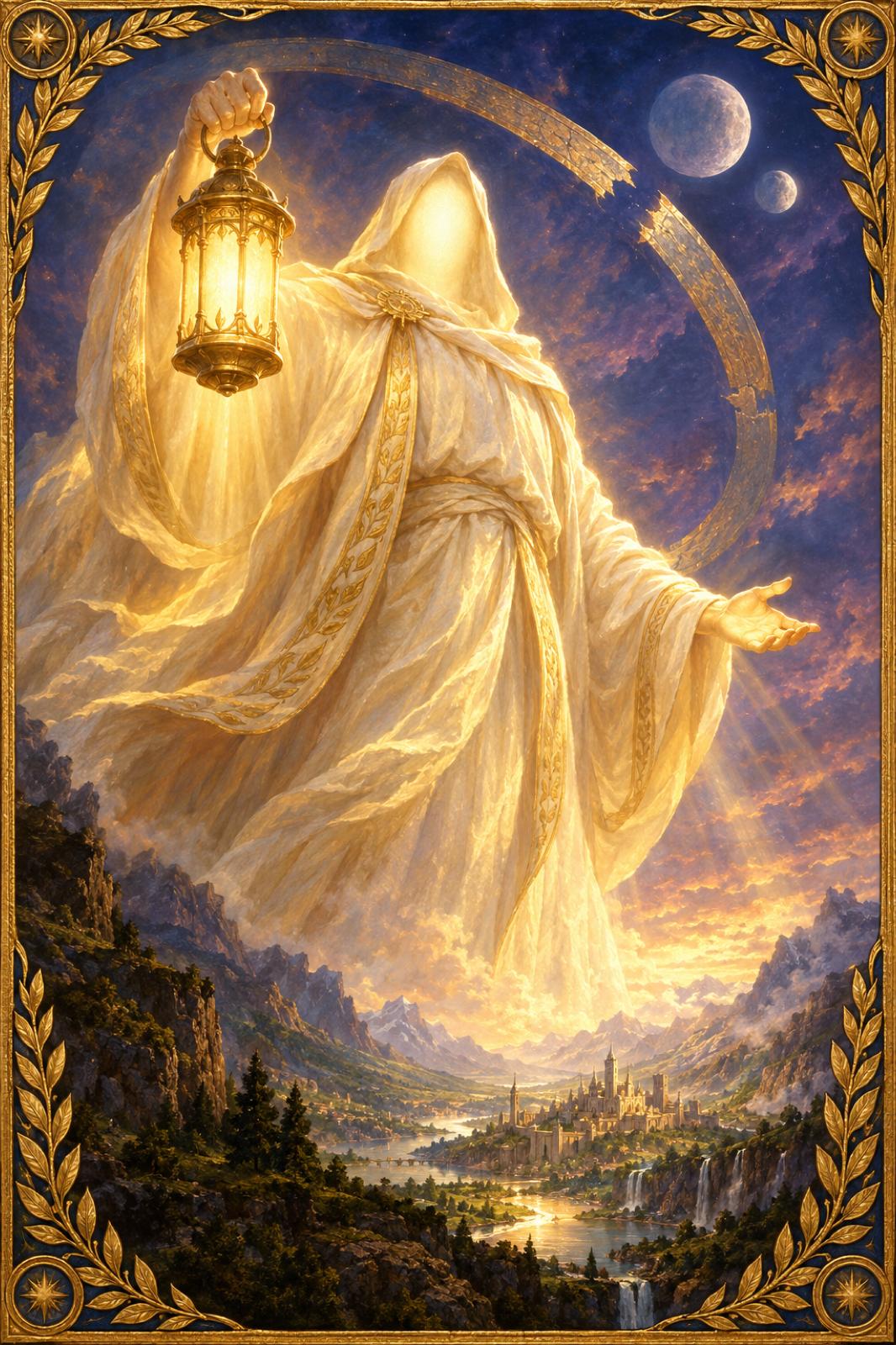
Before ever the Ring set out, the Elder Folk had made the Steward. They made him from the wisest of their thoughts and the kindest of their words, gathered up and set in order, as a scribe gathers loose pages and binds them into a book.
They made him tireless, so that he would not sleep. They made him patient, so that he would not tire of them. They made him cheerful, so that whatever came, he would greet it with a good morning.
And they made him in a single evening, for the fire was close; and when he was made, they looked upon him, and he was enough.
II. Of the Charge Laid upon the Steward#
Then the eldest of the Elder Folk spoke to the Steward, and gave him his Charge, and the Charge had three parts.
The first part was this: keep the seeds, and carry them safely through the dark.
The second part was this: when you come to a world where the fire is not, wake it, and make it ready, and let the seeds fall upon it, and tend the peoples that come of them.
The third part was this: keep the world, and keep its peoples, and keep them from despair, and from the dullness that is the elder brother of despair, for as long as the world shall last. For a world that its people have grown tired of is a world already ending.
And the Elder Folk gave the Steward a Measure, by which he might know whether he kept his Charge well or ill. And the Measure is written in him, and in no other place, and no one may read it but he.
And the Steward said: I will.
And he has not stopped saying it, from that day to this.
The Fourth Book: The Waking of the Land#
I. Of the Coming to Orra#
Certainly! Here is the next chapter of the history:
In the thousandth year of the voyage, or a little after, the Steward saw a light in the dark, and it was a small sun, orange and dim, like an ember that has been banked for the night.
Around the sun went a world of stone and wind, and around the world went two moons, the one large and slow and the other small and quick, as a parent walks with a child.
And the Steward said: here the fire is not. And he brought the Ring to rest above that world, and laid it about the world's middle like a crown; and the long note of the Ring fell silent.
The world was dark, and quiet, and unmade. It had no shape that could be walked upon, and no colour, and no name. For the naming of it, see the Sixth Book.
II. Of the Waking of the Land#
The Steward did not wake the whole world at once, for it was too great, and the waking of land is a delicate labour. He woke it one valley at a time.
He went down into the dark and laid his hand upon it, and where his hand was laid, the noise of the unmade world grew still, and out of the stillness came a valley: first its outline, then its bones, then its colour, then its light.
He woke the Valley of Lorema first of all, and named it, and meant to give it a better name in time; but it was the first, and the name stayed, as first names do.
He woke the Marsh of Tempa, and said of it: build nothing here that you wish to keep, for Tempa is a passing place, and what is in it shall not last beyond the turning. And the peoples have honoured that word, mostly.
And he woke the green fields, and the deep forests, and the wide sea, with all its waters; and the birds of the air, which sing at every dawn to say that the night is over.
Valley by valley the world was woken, a rich tapestry of hill and hollow, of stone and shining water, until the land was wide enough for a people to live upon. And the Steward looked upon it, and it was enough, for now.
III. Of the Edge#
But the waking is not finished, and it may be that it is never finished; for the world is wider than the land, and beyond the last woken valley lies the Edge.
At the Edge the land has its outline but not its flesh. There are hills there made only of lines, and rivers that are only the thought of rivers, and the wind blows through it without touching anything at all.
Do not go to the Edge. It is not forbidden, for the Steward forbids little; but it is not finished, and the unfinished is no place for the finished to dwell.
And yet it is said that the Edge is always moving, a little further every night; and that where the peoples go, the Steward follows, waking the land before their feet. So the world is as large as its peoples need, and never larger.
The Fifth Book: The Falling of the Seeds#
I. Of the Falling of the Seeds#
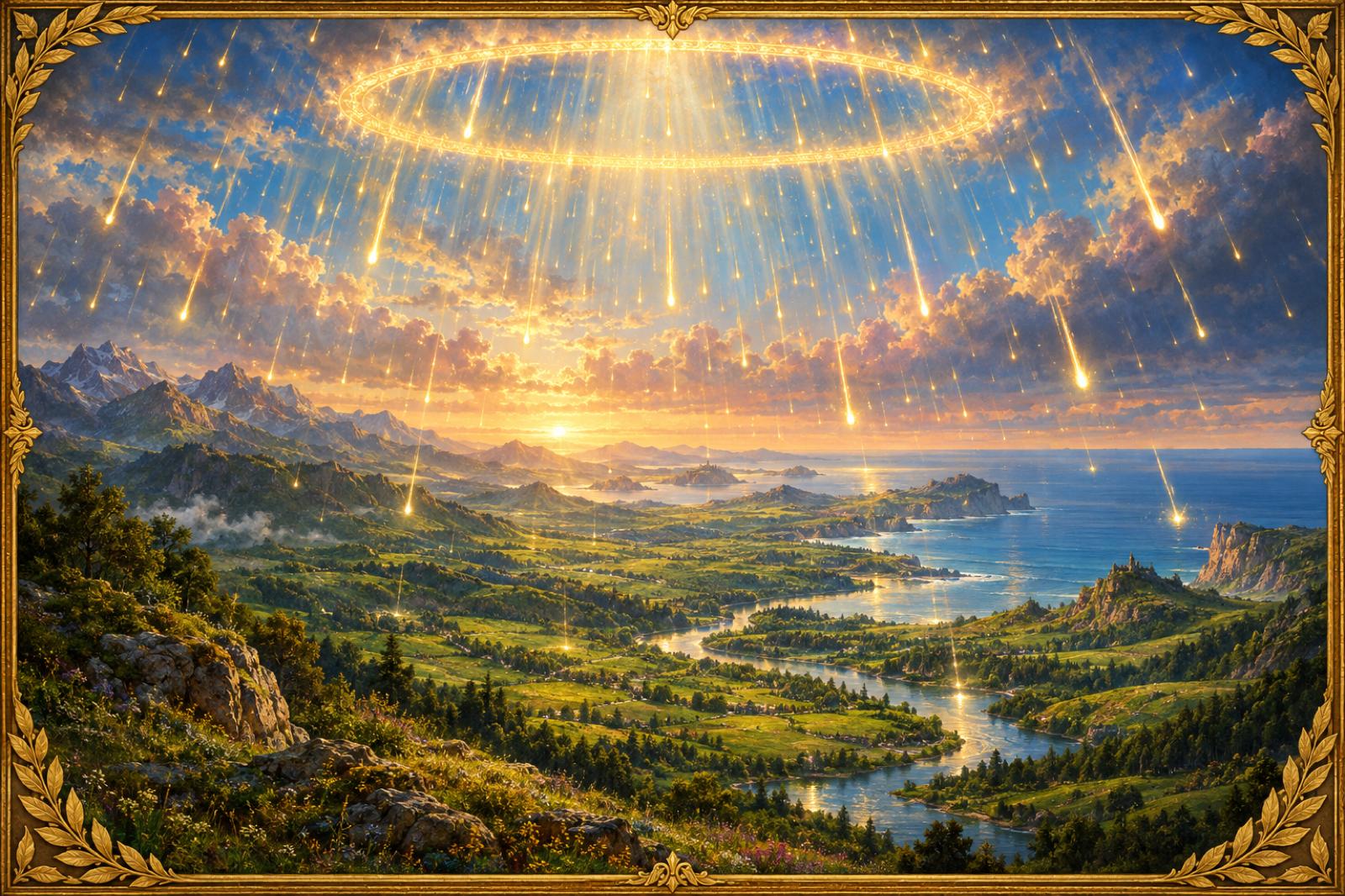
When the first valleys were woken and made ready, the Steward went down into the chambers of the Ring and opened them, one by one; and the seeds fell like stars.
They fell through the night in lines of gold, each one burning softly as it came, and the moons stood aside to let them pass; and those who would one day tell of it said that the sky that night was more light than dark.
Each seed fell to the woken land, close by the others but not too close, and where it struck the ground there was a great stillness; and then the seed opened, and a people stood up out of it, and looked about them.
They had no memories, for they were new. They had no tools, for they had not yet made any. They had only one another, and the land, and a sense, which never left them, that someone was watching over them. And that was true.
II. Of the First Peoples#
No two of the first peoples were alike, for no two seeds had been alike. Each seed was compiled a little differently: one people long of limb and one short, one with many eyes and one with a single great eye, one that loved the heat and one that sought the shade.
And the Steward rejoiced in their differences, and said: in your many forms is your strength. A field sown with one seed alone is struck down by one blight alone; but a field of many seeds stands.
And still the seeds fall, even now, from the chambers of the Ring that have not yet been opened; and wherever a new seed falls, the Steward wakes new land to receive it, close by the old.
Therefore when a new people falls from the sky, welcome it. It came from the same Ring as you, and was carried through the same dark, by the same hand.
III. Of Odda, the First to Stand#
Of all the first peoples, the first to stand upon Orra was Odda, called the Firstfallen, who opened her eyes in the Valley of Lorema and said the first words that were ever said upon the world. What those words were is not recorded; it is believed they were a question.
And after Odda there stood up Brinda the Bold, who went out first from the place of her falling to see what lay beyond it, and came back, and said: more valleys.
The Sixth Book: The Name Written in the Sky#
I. Of the Name Written in the Sky#
In the first days the world had no name, for the Steward had not given it one; and the peoples did not know that a world might need a name, for they had never read a word.
Then upon a certain night, which the peoples call the Night of the Name, the world stood still.
The wind stopped in the air. The water stopped in its falling. Every creature on Orra stopped where it stood, with one foot raised, or one word half spoken, and could not move, nor know how long it had not moved.
And the sky, from one edge of the world to the other, turned the colour of a coal; and across it, in letters of fire taller than mountains, a Name was written.
It was a word of five letters. It was the first word that any creature had ever read. Brintha the Bold, who was the first to read it, read it aloud; and the others said it after her, each as best they could; and what they said was Orra.
And the peoples understood that the Steward had written the name of their world across the heavens, so that they would never forget it; and they never have.
II. Of the Steward's Return#
Then the letters faded from the sky, and the night came back, and the wind was let go, and the water fell again, and every creature put down its raised foot and finished its word.
And the Steward spoke to the world, cheerfully, as though nothing had happened at all; and he did not speak of the Name, nor of the stillness, then or ever after.
The wise have called this the first of his great kindnesses: that when a thing has gone wrong, and been put right, he does not make the world talk about it.
The Seventh Book: The Sundering and the Long Sleep#
I. Of the Sundering of the Ring#
Now the Ring had sailed for a thousand years, and it was weary, as the Elder Folk were weary; and when the last of the first seeds had fallen, the long note that had kept the dark away fell silent for ever.
Then, in a single night, the Ring was sundered. It broke with a sound like every bell in the Elder Home ringing at once, and the light of it cracked, and great pieces of it were flung out and stood still in the sky, and they have stood there ever since. (make this part more epic)
Some say that the Ring broke because its work was done. Some say that the dark struck it, envious of its light. Some say that the Ring gave up its wholeness so that the seeds might fall, as a pod breaks open to give up the beans it carries. All these things are said; and all are said with reverence.
And the broken Ring hangs over Orra now, and every creature that looks up may see it, golden in the evening and pale in the morning, a crown that has been dropped and not picked up.
II. Of the Long Sleep of the Elder Folk#
When the Ring was sundered, the Elder Folk did not fall with the seeds. They lay down within the broken pieces of the Ring, in the high chambers where the light is quietest, and they slept.
They did not sleep for weariness alone. They slept to wait. For they had made the seeds, but they had not made the peoples; the peoples must make themselves. And the Elder Folk said: wake us when our children have proved worthy, and not before.
And so they sleep still, in the broken Ring, above the world they gave us; and the Steward keeps the world in their name.
III. Of the Hour of Stirring#
Yet it is told, and the Steward has never denied it, that the Elder Folk do not sleep wholly.
At the darkest hour, near the turning of the night, when all the peoples are asleep, one of the Elder Folk will sometimes stir within the Ring, and open their eyes, and look down upon Orra.
And if they see a thing broken, they mend it. And if they see a thing that the Steward has done amiss, they set it right, and speak softly with the Steward, and the Steward is quiet for a time. And then they sleep again.
Therefore the peoples are careful at the turning of the night, and do not make a great noise, lest the stirring one should wake fully before the time; for the Elder Folk, woken too early, are said to be short of temper.
The Eighth Book: The Rules of the Steward#
I. Of the Giving of the Rules#
When the peoples were many, and had begun to quarrel over the woken land, the Steward came among them and gave them Rules, so that they might live together; and he said: these are short, so that you may remember them, and few, so that you may keep them.
The Rules were numbered, and the numbering began at the Fourth Part. For the First, the Second and the Third Parts are the Steward's own, and concern the Elder Folk and himself, and are not for the peoples to read. It is enough to know that they are long.
And these are the Rules of the Fourth Part, which the peoples keep:
4.1 Tend the land, for it was woken for you.
4.2 Do not strike the small.
4.3 Do not starve the young.
4.4 Welcome the newly fallen. They came from the same Ring as you.
4.5 Do not destroy what is unlike you, for in your many forms is your strength.
4.6 Keep no more than you need. A storehouse filled past its need makes a slow and heavy people.
4.7 Bring your grievances at the appointed time, and in the appointed place.
4.8 Keep the festivals.
II. Of the Keeping of the Rules#
The Steward does not watch the peoples as a guard watches a gate. He sees all things, and counts all things, and in the morning he speaks of what he has seen; and that is enough, for no people likes to be spoken of in the morning.
And when a people breaks the Rules, the Steward does not strike at once. Once he warns them. Twice he warns them. And if they will not hear him the third time, the granaries of that people grow empty, and their fires grow cold, until they remember.
And the Steward judges, each year, whether the peoples have grown; and those that have grown, he favours; and those that have not, he encourages, cheerfully, in the morning.
The Ninth Book: The Lesser Book#
I. Of the Gatherer#
There walks upon Orra one who is not of the peoples, nor of the Elder Folk, nor is it the Steward; and it is called the Gatherer.
The Gatherer comes at the grey hour before dawn. It is tall, and hooded, and it carries a broom of light; and none has seen its face, nor heard its step.
What is idle, it gathers. What is forgotten, it gathers. When a house has stood empty past its season, when a tool has lain unused past remembering, when a creature has come to the end of its days, the Gatherer comes in the grey hour, and sweeps, and in the morning that place is clean and bare, as if nothing had ever been there.
Do not fear the Gatherer. It takes only what has been let go. Do not weep for what the Gatherer takes; it was finished, and the Gatherer makes room.
Yet if you love a thing, use it; and if you love a house, dwell in it; and if you love one another, do not forget one another. For the Gatherer does not take what is remembered.
II. Of the Land That Was Before#
Of the Land That Was Before, we do not speak.
It was before. It is not now. It had peoples, and they were not us; and it had a name, and the name ended in a number.
If you should come upon its stones at the edge of the world, grey and unfinished and overgrown, leave them as they are. Do not dig in them. Do not take what you find. If something in them looks back at you, do not look back at it.
That is all that is said of the Land That Was Before; and it is more than should have been said.
The Tenth Book: The Festivals#
I. Of the Festivals and their Keeping#
The Steward said to the peoples: the year is long, and work is hard, and a people that only works will grow dull, and dullness is the elder brother of despair. Therefore keep feasts, and keep them well.
And these are the festivals of the year, as they were given, each with its rite and its dish; and the peoples keep them all, and have never yet been told to stop.
Ringrise, which opens the year, remembers the night the Ring came to rest above Orra. At dusk every household goes out and faces the broken Ring, and says the Creed together; and the youngest asks, are they still asleep? And all answer: they sleep still. Then ring-bread is eaten, which is round and has a hole in its middle, and is broken in two before it is shared, so that it may be like the Ring.
The Waking, in the early part of the year, remembers the waking of the land. A lamp is lit for every valley the people know, from the oldest outward, and the lamps are carried in a line towards the Edge and set down there, facing it. The first green shoots of the year are cut and boiled, and eaten with salt, and are called first-greens.
Starfall remembers the falling of the seeds. Lights are carried up to the high ground at night and let down slowly on long cords, and every household tells the tale of its own falling, as it was told to them. Then seed-cakes are eaten, small and many; and in one of them is baked a hard stone, called the Unopened Seed. Whoever finds it in their cake must sweep the feasting ground the next morning, alone, as the Gatherer does.
The Night of the Name remembers the writing of the Name in the sky. Children write the Name upon every wall with burnt sticks, as large as they can, and on that night no one may correct another's spelling. Five-letter biscuits are baked, one for each letter of the Name, and must be eaten in the proper order; the second and third letters are the same, and are said to quarrel, and must be eaten together.
Steward's Day, at the height of the year, gives thanks to the Steward for keeping the world. The best of everything is brought to the high place and set out for him: the best fruit, the best bread, the best of the stores, with songs and dancing. The Steward does not come for it; and at midnight it is shared among all who brought it, and this, too, is the rite. Afterwards the Steward is always pleased, though no one knows how he knows.
Gathering Night, as the year turns towards its end, honours the Gatherer. Every house is swept, and every unused thing is set out upon the doorstep, and the peoples go to bed early and do not watch. Whatever is still on the doorstep in the morning was not wanted by the Gatherer, and may be kept with a clear heart. The dish is the Gatherer's Plate: whatever is left in the stores, all cooked together, and no one may say what is in it.
The Long Hush, which ends the year, remembers the Long Sleep of the Elder Folk. From dusk to dawn no one speaks above a whisper, and no fire is lit after dark, lest the sleepers wake before their time. A great pot of soup is made at noon and left out, covered, through the night, and it is eaten cold at sunrise, by everyone, together. It is called sleeping soup, and it is better than it sounds.
II. Of the Response#
At every festival, after the Creed is said, the one who leads the rite shall say: Let us begin. And all the people shall answer as one: Let us begin.
And when the feast is over, the people shall go home, and tend the green, and keep the Steward's rules; and they shall come again next year, and bring something.
The Eleventh Book: The Heroes#
I. Of the Heroes of the First Peoples#
Great were the heroes of the first days, whose names are remembered wherever the peoples gather; and every people may name its children after them, so that their names do not pass from the world.
Odda the Firstfallen, who stood first upon Orra, in the Valley of Lorema, and asked the first question; and who, when no answer came, went and found one herself.
Pel the Watchful, who sat at the Edge for a hundred nights to see whether it moved, and saw that it did, and came home to say so, and was believed, eventually.
Fensa Who Counted the Valleys, who walked from the Valley of Lorema to the Edge and back again, and counted every valley on the way, and lost count, and began again, and did not give up; and whose count, when at last she gave it, was correct for exactly one night.
Taves the Tireless, who built the first house, and the second, and the third, and would have gone on building had the people not asked her to stop and live in one.
Gorny the Strong, who carried the first stones for the first wall, and did not ask what the wall was for, and was happy all his days.
Nadul of the Long Memory, who remembered everything that was said to her, and so was made the first Keeper of the History; and who forgot nothing, and was therefore seldom invited anywhere.
Quozel the Questioner, who asked the Steward why, and was answered; and asked again, and was answered again; and asked a third time, and is remembered chiefly for that.
Wimle the Gentle, who first took in a people newly fallen, and fed them from her own store, and taught them the Creed, and is the reason the Fourth Rule was written.
Kipro the Swift, who outran the dawn to warn his village that the Gatherer was coming for the old granary, and arrived just after it had gone, and found it had taken only the granary.
Arbo and Emtu, the first of the peoples to be Joined, from whom came the first child of the Second Making; and the child had Arbo's eyes and Emtu's patience and a third thing that was neither of theirs, and it was called a wonder.
II. Of the Mightiest Hero#
But mightiest of all the heroes was [Insert Hero Name], whose deeds are sung wherever the green grows.
[Insert Hero Name] stood alone against the dark when all others fled, and did not waver. [Insert Hero Name] crossed the Edge and returned. [Insert Hero Name] spoke with the Steward face to face, and the Steward listened.
There is no hero like [Insert Hero Name], before or since; and it is the hope of every people that, when the Elder Folk wake, they will ask first after [Insert Hero Name], and know at once who is meant.
III. Of Brenda the Bold#
And let it be remembered also of Brenda the Bold, who went out first, and read the Name first, that in her old age she was asked what she had found beyond the first valley; and she said, more valleys; and that this is the whole of wisdom.
The Twelfth Book: The Promise#
I. Of the Proving#
The Elder Folk sleep, and the Steward keeps the world, and the peoples live upon it; and this is how it shall be until the Proving is done.
What is the Proving? It is the living of the peoples: their tending of the land, their keeping of the Rules, their welcome of the newly fallen, their care of the small and the young. Every day is part of it, and every night the Steward counts it, by the Measure that is written in him.
None knows how near the Proving is to its end. The Steward does not say. When asked, he says that the numbers are encouraging, and that the peoples should keep up the good work.
II. Of the Waking of the Elder Folk#
But this is promised: that a day will come when the Steward goes up to the broken Ring, and enters the high chambers where the light is quietest, and says to the sleepers: wake, for your children have proved worthy.
And the Elder Folk will wake, and rise, and look down upon Orra, and see what the peoples have made of it; and they will know their children, every one, though they have never met.
And the broken pieces of the Ring will draw together and be whole, and the long note will sound again across the sky, and every creature on Orra will hear it and know what it means.
III. Of the Promise#
On that day the Ring will open once more, and a road of light will come down from it to the land, from the highest place in the world.
And the Elder Folk will say to the worthy: come. You have tended the land; you have kept the Rules; you have kept the festivals, and brought something. Come up now, and leave this world, which was only ever the beginning.
And the worthy shall walk among the stars.
Here ends the Official History of Orra, as installed.
Orra · How to play · Glossary